publications
Publications are sorted in reversed chronological order.
2026
2025
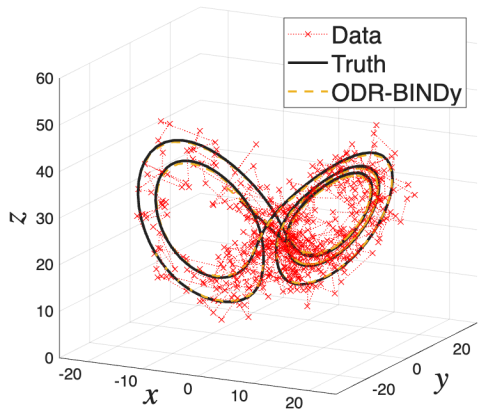
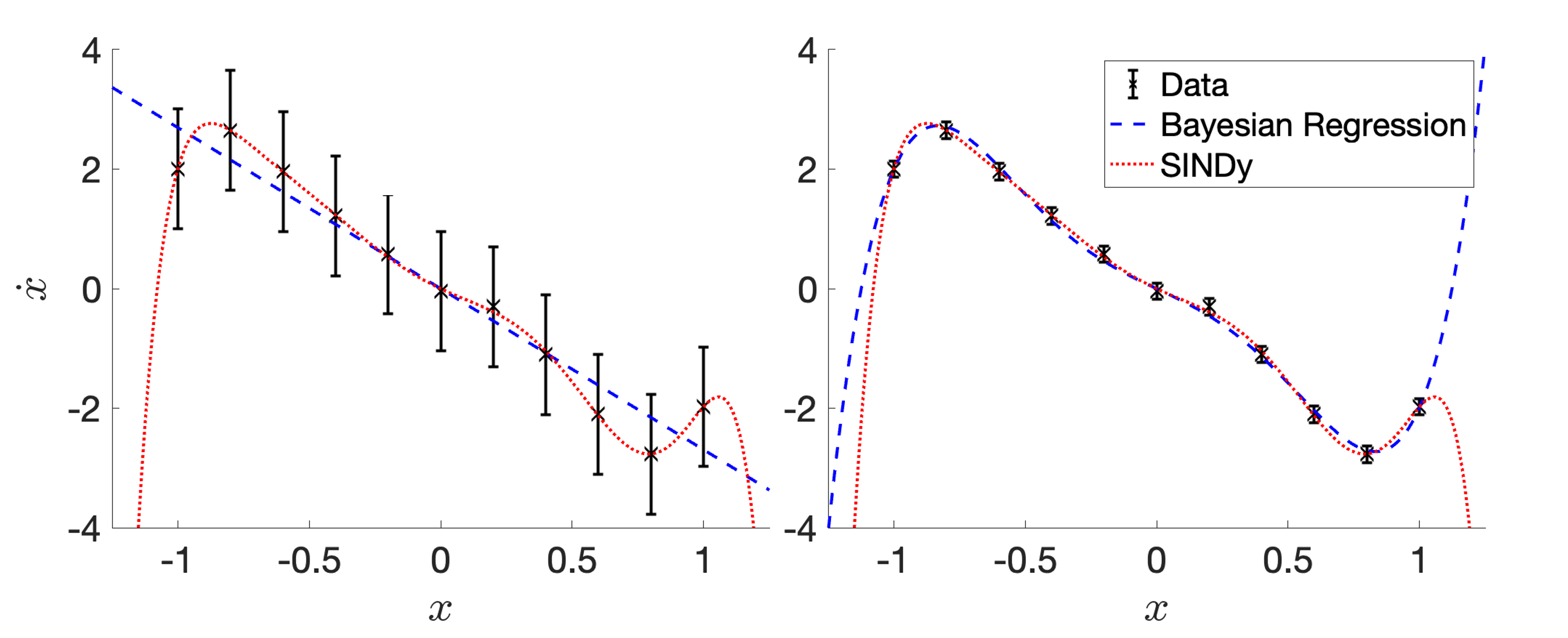
- Rapid Bayesian identification of sparse nonlinear dynamics from scarce and noisy dataLloyd Fung, Urban Fasel, and Matthew JuniperProc. R. Soc. A. Paper for the software package B-SINDy , Feb 2025
We propose a fast probabilistic framework for identifying differential equations governing the dynamics of observed data. We recast the sparse identification of nonlinear dynamics (SINDy) method within a Bayesian framework and use Gaussian approximations for the prior and likelihood to speed up computation. The resulting method, Bayesian-SINDy, not only quantifies uncertainty in the parameters estimated but also is more robust when learning the correct model from limited and noisy data. Using both synthetic and real-life examples such as lynx–hare population dynamics, we demonstrate the effectiveness of the new framework in learning correct model equations and compare its computational and data efficiency with existing methods. Because Bayesian-SINDy can quickly assimilate data and is robust against noise, it is particularly suitable for biological data and real-time system identification in control. Its probabilistic framework also enables the calculation of information entropy, laying the foundation for an active learning strategy.
- PTRSA
 Foundation and challenges in modelling dilute active suspensionsLloyd Fung, Hakan O. Caldag, and Martin A. BeesPhil. Trans. R. Soc. A, Feb 2025
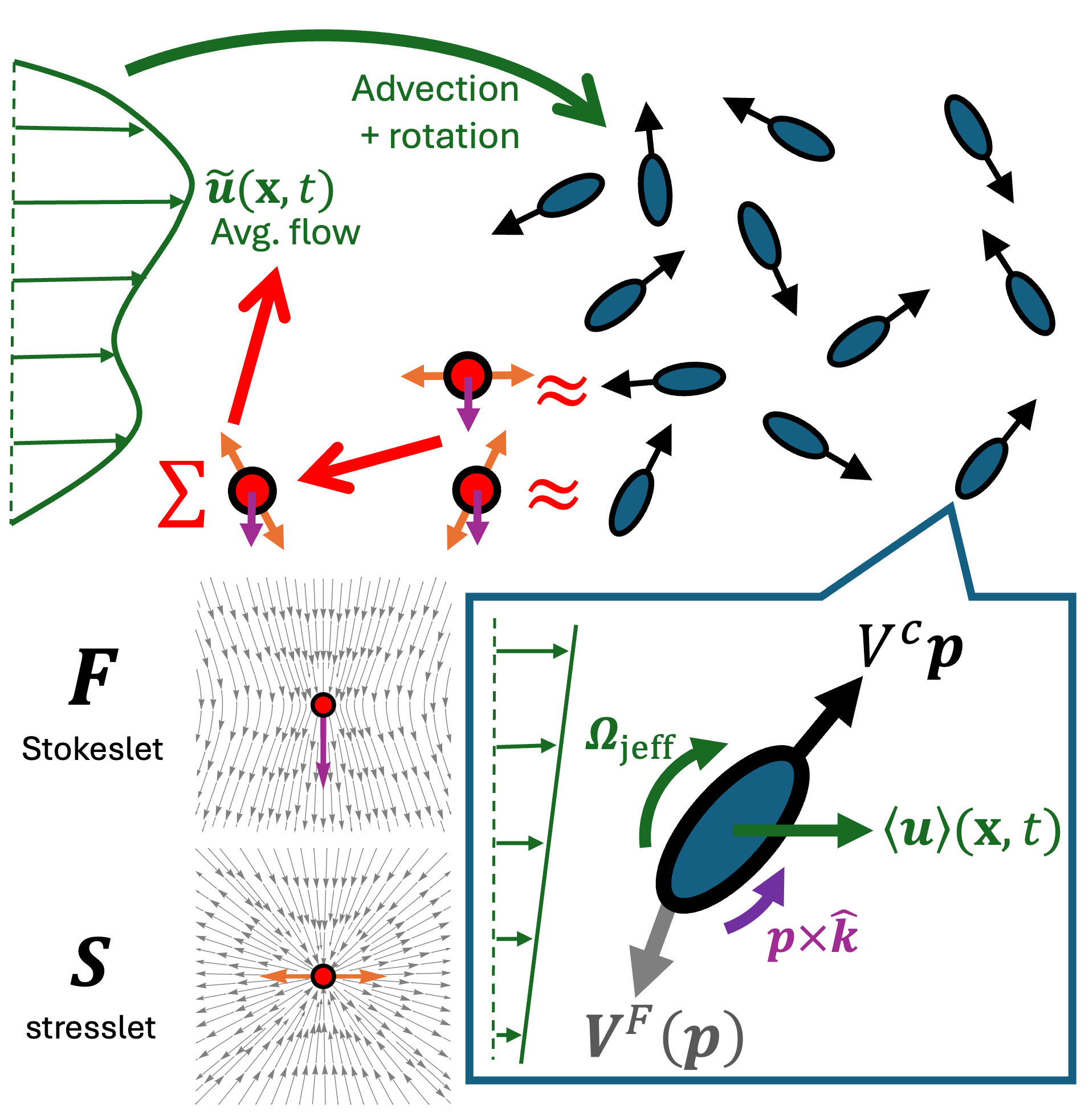
Active suspensions, which consist of suspended self‑propelling particles such as swimming microorganisms, often exhibit non‑trivial transport properties. Continuum models are frequently employed to elucidate phenomena in active suspensions, such as shear trapping of bacteria, bacterial turbulence and bioconvection patterns in suspensions of algae. Yet, these models are often empirically derived and may not always agree with the individual‑based description of active particles. Here we review the essential coarse‑graining steps to develop commonly used continuum models from their respective microscopic dynamics. All the assumptions needed to reach popular continuum models from a multi‑particle Fokker–Planck equation, which governs the probability of the full configuration space, are explicitly presented. In the dilute limit, this approach leads to the mean‑field model (a.k.a. Doi–Saintillan–Shelley model), which can be further reduced to a continuum equation for particle density. Moreover, we review the limitations and highlight the challenges related to continuum descriptions, including significant issues in implementing physical boundary conditions and the possible emergence of singular solutions.
2023

- Swimming, Feeding, and Inversion of Multicellular Choanoflagellate SheetsLloyd Fung, Adam Konkol, Takuji Ishikawa, and 3 more authorsPhys. Rev. Lett., Oct 2023
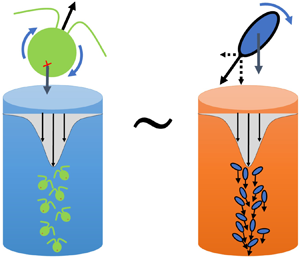
- Analogy between streamers in sinking spheroids, gyrotactic plumes and chemotactic collapseLloyd FungJ. Fluid Mech., Apr 2023
In a dilute suspension where sinking spheroids or motile gyrotactic micro-organisms are modelled as orientable and negatively buoyant particles, we have found analytical solutions to their steady distributions under any arbitrary continuous vertical shear flow. The two-way coupling between their distribution and the vertical flow is nonlinear, enabling the uniform base state to bifurcate into a structure reminiscent of the streamers in settling spheroid suspensions and gyrotactic plumes. This bifurcation depends on a single parameter that is proportional to the average number of particles on a horizontal cross-section. In a three-dimensional axisymmetric system, the plume structure blows up when the parameter is above a threshold. We discuss how this singularity is analogous to the chemotactic collapse of a Keller–Segel model, and the significance that this analogy entails.
2022
- Instability of Tilted Shear Flow in a Strongly Stratified and Viscous MediumLloyd Fung and Yongyun HwangIn IUTAM Laminar-Turbulent Transition, Jul 2022
It is well known that stratification can stabilise shear flow. In a vertical shear flow, the Miles-Howard’s criterion firmly indicates that flow should be stable if the local Richardson number is greater than one fourth. However, if shear is tilted with a non-zero angle from vertical, an instability can arise even under very strong stratification, and such an instability was recently observed in a titled wake flow at low Reynolds number (Meunier 2012, J. Fluid Mech., 699:174). In the present study, we showed that in the limit of low Froude number and low Reynolds number, the linearised equations of motion could be reduced to the Orr-Sommerfeld equation on the horizontal plane, except the viscous term that contains vertical dissipation. Based on this equation, it is demonstrated that the low-Froude-number mode would be a horizontal inflectional instability, and should remain two dimensional at small tilting angles. It is further shown that the emergence of small vertical velocity at finite Froude number modifies the horizontal inflectional instability and leads to paradoxically stabilising buoyancy force on increasing Froude number. Finally, an absolute instability analysis is performed, revealing qualitatively good agreement with the experimental result.
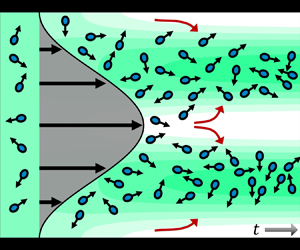
- A local approximation model for macroscale transport of biased active Brownian particles in a flowing suspensionLloyd Fung, Rachel N. Bearon, and Yongyun HwangJ. Fluid Mech., Jan 2022
A dilute suspension of motile microorganisms subjected to a strong ambient flow, such as algae in the ocean, can be modelled as a population of non-interacting, orientable active Brownian particles (ABPs). Using the Smoluchowski equation (i.e. Fokker–Planck equation in space and orientation), one can describe the non-trivial transport phenomena of ABPs such as taxis and shear-induced migration. This work transforms the Smoluchowski equation into a transport equation, in which the drifts and dispersions can be further approximated as a function of the local flow field. The new model can be applied to any global flow field due to its local nature, unlike previous methods such as those utilising the generalised Taylor dispersion theory. The transformation shows that the overall drift includes both the biased motility of individual particles in the presence of taxis and the shear-induced migration in the absence of taxis. In addition, it uncovers other new drifts and dispersions caused by the interactions between the orientational dynamics and the passive advection–diffusion of ABPs. Finally, the performance of this model is assessed using examples of gyrotactic suspensions, where the proposed model is demonstrated to be most accurate when the biased motility of particles (i.e. taxis) is weak.
2020
- Linear instability of tilted parallel shear flow in a strongly stratified and viscous mediumLloyd Fung and Yongyun HwangJMST Advances, Jun 2020
A linear stability analysis is performed on a tilted parallel wake in a strongly stratified fluid at low Reynolds numbers. A particular emphasis of the present study is given to the understanding of the low-Froude-number mode observed by the recent experiment (Meunier in J Fluid Mech 699:174–197, 2012). In the limit of low Froude number, the linearised equations of motion can be reduced to the Orr–Sommerfeld equation on the horizontal plane, except the viscous term that contains vertical dissipation. Based on this equation, it is proposed that the low-Froude-number mode would be a horizontal inflectional instability and should remain two-dimensional at small tilting angles as long as the Reynolds number is sufficiently low. To support this claim, the asymptotic regime where this analysis is strictly valid is subsequently discussed in relation to previous work on the proper vertical length scale. The absolute and convective instability analysis of parallel wake is further performed, showing qualitatively good agreement with the experimental result. The low-Froude-number mode is found to be stabilised on increasing Froude number, as in the experiment. It is shown that the emergence of small vertical velocity at finite Froude number, the size of which is proportional to the square of Froude number, plays the key role in the stabilisation by modifying the inflectional instability and paradoxically creating stabilising buoyancy effect with the increase of Froude number.
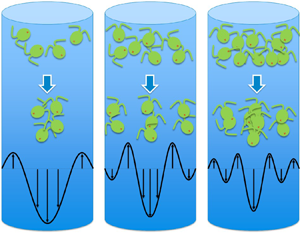
- A sequence of transcritical bifurcations in a suspension of gyrotactic microswimmers in vertical pipeLloyd Fung and Yongyun HwangJ. Fluid Mech., Nov 2020
Kessler (Nature, vol. 313, 1985, pp. 218–220) first showed that plume-like structures spontaneously appear from both stationary and flowing suspensions of gyrotactic microswimmers in a vertical pipe. Recently, it has been shown that there exist multiple steady, axisymmetric and axially uniform solutions to such a system (Bees & Croze, Proc. R. Soc. A, vol. 466, 2010, pp. 2057–2077). In the present study, we generalise this finding by reporting that a countably infinite number of such solutions emerge as the Richardson number increases. Linear stability, weakly nonlinear and fully nonlinear analyses are performed, revealing that each of the solutions arises from the destabilisation of a uniform suspension. The countability of the solutions is due to the finite flow domain, while the transcritical nature of the bifurcation is because of the cylindrical geometry, which breaks the horizontal symmetry of the system. It is further shown that there exists a maximum threshold of achievable downward flow rate for each solution if the flow is to remain steady, as varying the pressure gradient can no longer increase the flow rate from the solution. All of the solutions found are unstable, except for the one arising at the lowest Richardson number, implying that they would play a role in the transient dynamics in the route from a uniform suspension to the fully developed gyrotactic pattern.
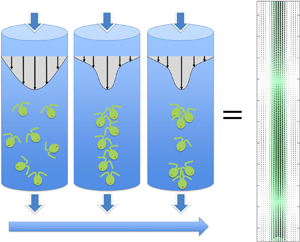
- Bifurcation and stability of downflowing gyrotactic micro-organism suspensions in a vertical pipeLloyd Fung, Rachel N Bearon, and Yongyun HwangJ. Fluid Mech., Sep 2020
In the experiment that first demonstrated gyrotactic behaviour of bottom-heavy swimming microalgae (e.g. Chlamydomonas), Kessler (Nature, vol. 313, 1985, pp. 218–220) showed that a beam-like structure, often referred to as a gyrotactic plume, would spontaneously appear from a suspension of gyrotactic swimmers in a downflowing pipe. Such a plume is prone to an instability to form blips. This work models the gyrotactic plume as a steady parallel basic state and its subsequent breakdown into blips as an instability, employing both the generalized Taylor dispersion (GTD) theory and the Fokker–Planck model for comparison. Upon solving for the basic state, it is discovered that the steady plume solution undergoes sophisticated bifurcations. When there is no net flow, there exists a non-trivial solution of the plume structure other than the stationary uniform suspension, stemming from a transcritical bifurcation with the average cell concentration. When a net downflow is prescribed, there exists a cusp bifurcation. Furthermore, there is a critical concentration at which the cell concentration at the centre would blow up for the GTD model. The subsequent stability analysis using the steady plume solution shows that the Fokker–Planck model is inconsistent with what was experimentally observed, as it predicts stabilisation of axisymmetric blips at high concentration of the plume and destabilisation of the first non-axisymmetric mode at low flow rates.